

Happiness and satisfaction are not goals: They are "means" to ends
"Find '10%' happiness, not '100%'"
"I urge you to write your Nanjung-ilgi"
The "Worry Talk Talk Healing Concert," organized by the Hanyang Happiness & Dream Counseling Center, took place on November 8. Hanyang University Counseling Center. The Worry Talk Talk Healing Concert featured Cognitive Psychologist and Professor Kim Kyung-il who gave a talk with the theme of "Wisdom for Minds: Communication and Happiness of Korean." We paid a visit to the lecture scene to learn "how to communicate to seek a happy life" with Professor Kim Kyung-il.
Happiness and satisfaction are not goals:
They are "means" to ends
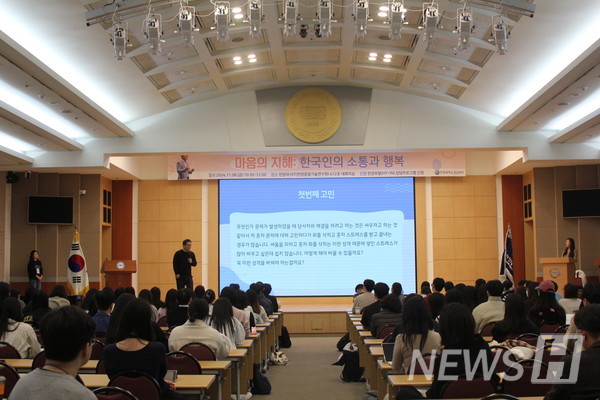
Professor Kim, quoting parts of his book, The Wisdom of Minds, argued that "happiness is not a goal, but a means to overcome hardship and adversities." He asked the audience if Korean society in 2024 frequently faces hardship or adversities. He remarked that Korea is the country with the most drama and hardships.
Korea was historically bound to experience suffering. "Loneliness comes from not being able to meet someone you want to meet, and stress comes from meeting someone you don't want to meet," said Professor Kim. "In his respect, Koreans, due to frequent outside invasions, cannot have any less stress." He added, "However, this allowed us to be better at responding to emergencies."
He defined Korea as a hyperalert society and concluded that happiness and satisfaction in Korea are not their size but their "frequency." According to him, Korean society is much better off to experience 10% happiness for 10 times than experiencing 100% happiness for once.
In the pursuit of "10%" happiness and not "100%"
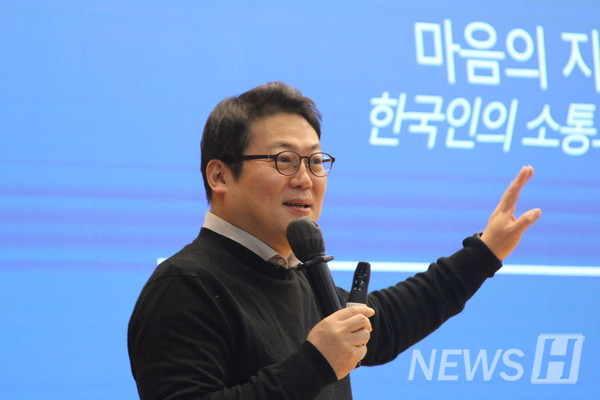
Professor Kim explained, "Those who keep 10% happiness after overcoming adversities make the tough 5%." Those who become the tough 5% are not those who record a handful of 100% happiness like getting into college, getting a dream job, or getting married, but it's those who keep and cherish small 10% happiness.
According to him, people can easily recall big events even if they don't record them, but 10% happiness will fade into oblivion if not recorded. Professor Kim explained, "Those who keep a good record of experience after adversities will find clues from those memories when similar events hit them."
Nanjung-ilgi by General Lee Sun-shin:
How about yours?
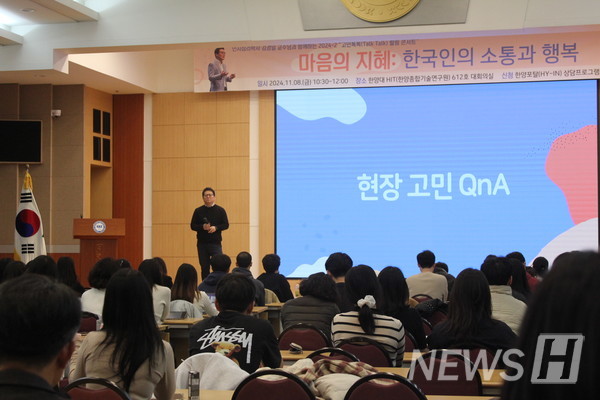
Who kept a good record then? Professor Kim picked "General Lee Sun-shin" as a historical figure with the most records of 10% happiness. "Most people remember cool phrases from Nanjung-ilgi," said Professor Kim. "However, the most frequent stories in Nanjung-ilgi are none other than eating, chatting, fooling around, ranting pains after being burnt out, and stories of wandering somewhere."
He continued, "I found one pattern in Nanjung-ilgi written from Imjin year to Musul year." Whenever General Lee Sun-shin faces adversities, he solves the problem by referring back to past records of similar adversities. It is said that he met someone who helped him find peace in his mind in the past or ate the same foods together with the same person, routinely overcoming hardships. We only know of General Lee Sun-shin as someone with immense determination, but he was a smart general who tried to find solutions for problems based on the 10% happiness of the past no matter how big of an adversity that finds him was.
Professor Kim urged the audience to write their own Nanjung-ilgi. "If you keep a record of your own 10% happiness, you will find yourself being in a situation that needs it," said Professor Kim. "If you keep looking after yourself like that, you will be a lot stronger."
 '한양위키' 키워드 보기