

Exploring ways to activate cooperation between Korea and Japan on issues of super-aging society and climate crisis
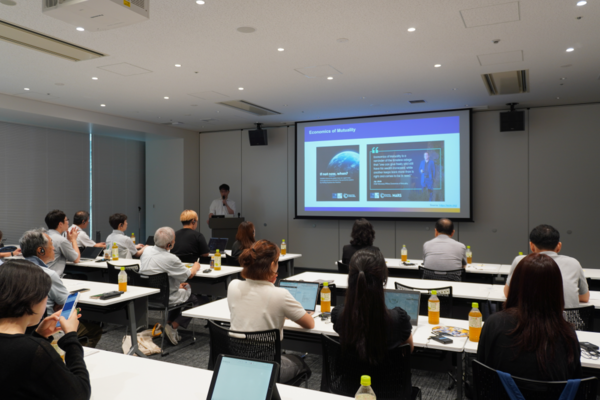
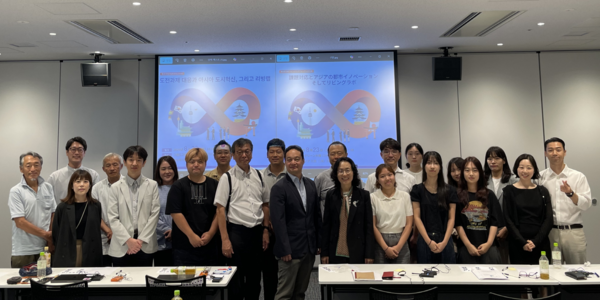
HUGE at Hanyang University(Shin Hyun-sang) announced that it co-hosted the 5th Korea-Japan Living Lab Network Forum on August 23 at Grand Green Osaka, Japan. The forum explored ways to activate cooperation between Korea and Japan to address national challenges such as regional declines and the climate crisis.
The Living Lab is a collaborative platform where citizens, industries, academia, research institutes, and government entities all come together to conduct innovative activities to solve pressing social issues. In this year’s forum, participating Korean institutions included HUGE, Yonsei University’s Climate Living Lab Research Group, the Korea Living Lab Network, the Science and Technology Policy Institute(STEPI), and Gongsaeng Co., Ltd, and Japan participants included Osaka University, the Human Augmentation Research Center from the Agency of Industrial Science and Technology(AIST), the Innovation Strategy Promotion Center of Tohoku University, and the sports brand Mizuno. Participants shared their outcomes on addressing the challenges of super-aging societies and climate crisis, while also discussing the necessity of expanding mutual cooperation and establishing a continent-wide Living Lab network for Asia.
In the presentation session, presenters from Korean institutions featured Shin Hyun-sang(Hanyang University), Seong Ji-eun(Senior Researcher, STEPI), Song Wi-jin (Chair of Policy Board, Korea Living Lab Network), and Lee Tae-dong(Head of Climate Living Lab, Yonsei University). On the other hand, presentations from Japanese institutions featured contributions from Professor Chihiro Ito(Office of Global Initiatives, Osaka University), Dr. Kentaro Watanabe(AIST), Yui Murakami (Visiting Researcher, Osaka University’s Interdisciplinary Research Institute), and Tetsuda Yamada(Researcher, Tohoku University), each sharing updates on their respective initiatives and projects.
Shin Hyun-sang, Head of HUGE, stated, “Since its founding in 1939 with the educational philosophy of ‘Love in Deed and Truth,’ Hanyang University has emphasized education and research linked to social innovation and changemakership for more than a decade. This forum demonstrated that the Living Lab approach enables universities to apply their knowledge resources to solve social problems, while simultaneously linking the process of creating social value with education and research.”
Seong Ji-eun, Senior Research Fellow at STEPI, emphasized, “Korea and Japan are important economic partners as well as key partners to each other in responding to climate change, super-aging society, and natural disasters. Continuous knowledge exchange and the formation of joint markets are necessary to address these challenges.”
Shohei Nakamura, Deputy Director of the Collaborative Creation Center at Osaka University, remarked, “This collaboration marks a starting point for Korea and Japan to combine their strengths and jointly address global challenges such as climate change and infrastructure management. Through Living Lab practices grounded in fieldwork, we will contribute to building a safer and more sustainable society.”
The HUGE Team plans to use this forum as a springboard to strengthen cooperation with the Korea-Japan Living Lab Network and, leveraging the university’s strengths and resources, to promote and expand the establishment of an Asia-wide Living Lab Network.
Meanwhile, HUGE continues to operate a variety of social innovation programs that connect education, research, and practice, with the aim of creating social values and realizing a sustainable future. As Asia’s only Ashoka U Changemaker Campus, Hanyang University actively participates in global social innovation networks such as the Talloires Network and AVPN(Asia Venture Philanthropy Network). Since 2018, it has also partnered with Stanford University to publish the Korean edition of Stanford Social Innovation Review(SSIR), contributing to the development of both domestic and international impact ecosystems.
관련기사
- Hanyang SSIR Korea Center Hosts Impact Career Session at the '2nd Korea Social Value Festa'
- HYU–Eisai Korea Hold 'Dementia Café D-Cafe' Policy Promotion Living Lab Workshop
- Kidaribank x Hangaji: HYU Student Leaders Put Campus Sustainability into Practice
- HYU Global Social Innovation Foundation Concludes First Cohort of ‘Sustainable ESG Leadership Program 3.0’
- Driving Social Innovation at Hanyang: A Visit to the ‘Social Innovation Capstone PBL’ Final Presentations
- Global Social Innovation Center at HYU Successfully Holds Korea–Japan Living Lab Exchange with Osaka University
- Global Social Innovation Foundation at HYU Shares Local Coexistence Model at the 26th University Education Innovation Workshop
 '한양위키' 키워드 보기