

‘Ask a Book’ Chinese classics reading: Enjoying 100% by reading and experiencing Jehol Diary
Wisdom for living in the tumultuous 21st century, heard from Yeonam
"Classics are the Old Future": Recovering lost depth and thought
The ‘Ask a Book Chinese Classics Reading’ program, hosted by the Paiknam Academic Information Center, concluded its month-long journey. This program consists of special lectures where participants read the original text with a professor, and field trips to the actual locations featured in the classics. As a part of the ‘Humanities on the Road’ program connecting the library and the local community, it was open to both Hanyang students and local residents. It provides opportunities for residents to learn and a chance for students to explore the contemporary value of the classics.
Jehol Diary demonstrates the value of communication beyond prejudice
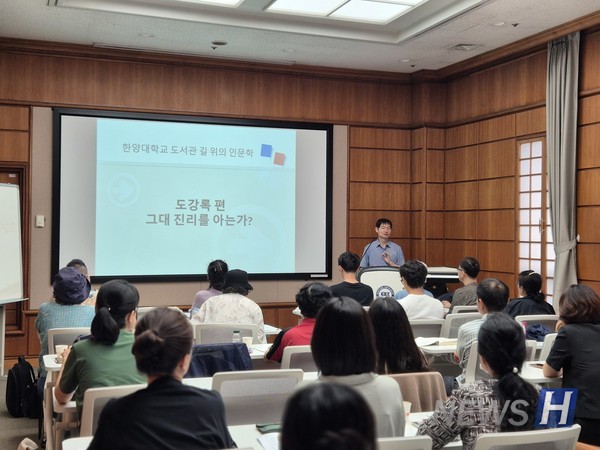
This year's selected classic was Jehol Diary (熱河日記) written by Yeonam* Park Ji-won. The Jehol Diary is considered one of the world's best travelogues and is an Yeonhaengrok detailing Yeonam's observations during his trip to Jehol, China—the first such journey by a Joseon official. A 'Yeonhaengrok' refers to a travel record written by an envoy to China in the late Joseon Dynasty. The lecture was led by Park Soo-mil, Research Professor at the East Asian Culture Research Institute, who has specialized in studying Joseon Silhak(Practical Learning) scholars, with a focus on Yeonam. Professor Park described the Jehol Diary as "a classic that demonstrates an overwhelming literary achievement among countless Yeonhaengroks."
*Yeonam is Park Ji-won's pen name, commonly used in ancient Asian Confucianism cultures to appreciate the person or to respect and not directly call names given by parents.
Yeonam offers lessons that remain valid in the 21st-century era of internationalization, transcending time. The Jehol Diary contains universal ethics for the coexistence of humanity. Yeonam shows human kindness that surpasses social status, such as worrying about the safety of the coachman and mingling freely with the groom. He also criticizes Joseon, which was narrowly focused on Confucianism, by asserting the need to show respect for Tibetan Buddhism. These are passages that reveal Yeonam’s consciousness of ontological equality, cultural relativism, open-mindedness, and respect for life. Professor Park explained, "Social media and algorithms confine people within walls. The communication Yeonam has demonstrated—transcending status, religion, and ideology—is a value that is even more necessary and precious for us today."
Kang Jin-ha(Department of Korean Language and Literature, Sophomore) said, "I felt an extraordinary quality in Yeonam, different from the nobleman of his time, in his aspect of not being bound by formality." Mr. Kang commented, "His attitude of communicating with various people without prejudice was impressive, and I think that attitude will help cultivate the insight needed for writing."
Walking Yeonam's footsteps on the Uiju-gil Field Trip
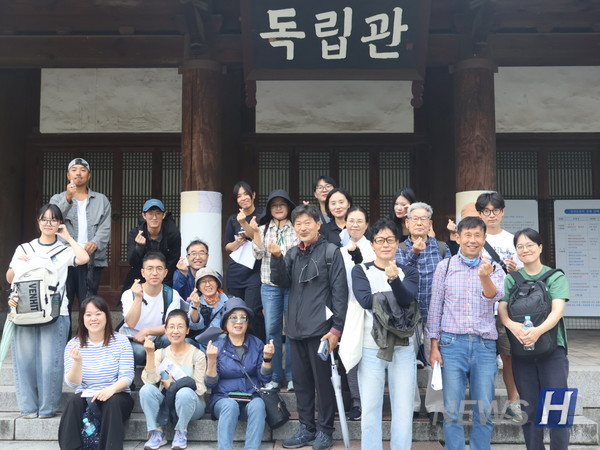
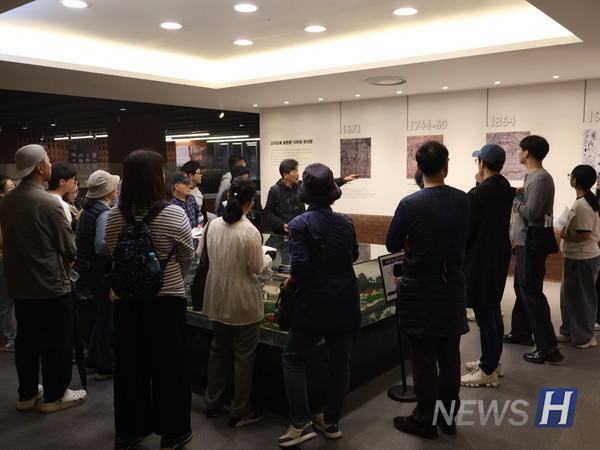
The participants stepped out of the classroom to explore the Uiju-gil, the actual route taken by diplomatic missions. The field trip was accompanied by Producer Shin Chun-ho, a specialist in Yeonhaeng and a documentary director. The route was planned with reference to Susa-rok (隨槎錄) by No I-jeom, which recorded the journey of the missions. The group followed the envoys' itinerary, starting from the old site of the Gyeonggi Provincial Office heading toward Hongje Bridge. About 25 students and local residents who participated in the Jehol Diary special lecture took part in the trip.
Lee Joon-hyeok(School of Computer Science, Sophomore) learned how to record travel through the field trip. Lee said, "I applied for the program because I usually enjoy traveling. Watching the Jehol Diary re-edited as a documentary, I learned various ways to record and remember spaces." He added, "I want to use skills I learnt majoring in Computer Science to attempt electronic archiving of spaces."
Classics are the old future
Professor Park stated that the Jehol Diary awakens the spirit of ‘Jeuksajinchwi (卽事眞趣)’ and ‘Seonbyeon (善變)’ in young people. Jeuksajinchwi is the attitude of seeking the true spirit in the present reality, independent of the past. At the time, Joseon acted based on 'Sungmyeong Baecheong', revering the fallen Ming and scorning the rising Qing as barbarians. In contrast, Yeonam recognized Qing as a powerful nation with advanced civilization. Therefore, Yeonam argued that Joseon should learn advanced knowledge and technology from the Qing Dynasty. He advocated the spirit of 'Iyonghuseng (利用厚生),' utilizing useful tools to enrich the lives of the people.
Seonbyeon refers to adapting for good. Yeonam respected the past but ultimately believed in changes. He held thoughts that only by facing reality without being confined to the past could one prepare for the future. Professor Park urged the students, "The 21st century is an era where even the immediate future is hard to predict. I hope you follow Yeonam's spirit, carefully examine the reality of the times, and grow into creative and challenging talents for the future society."
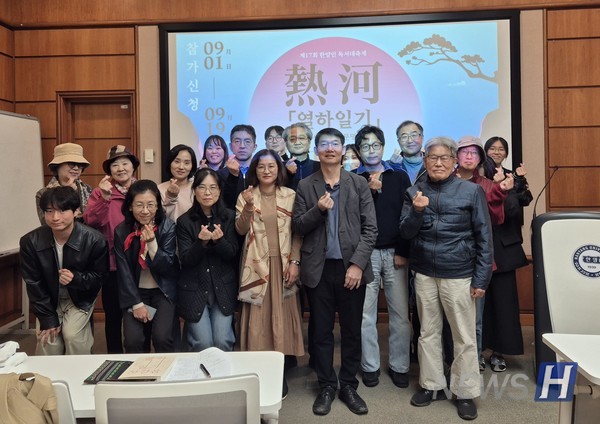
The current reality, where there isn't even a literature museum dedicated to Yeonam, shows how low the interest in Chinese classics is in Korea. Professor Park said, "It's natural to feel that Chinese classics and the language are distant. That distance is where the depth and reflection we have lost reside." He then advised, "Reading classics doesn't end with simply recalling the wisdom of the past. We must reflect upon our lives and ourselves today using the language and thoughts from the classics."
관련기사
- Hanyang Square: The Voice of Hanyangians Resonates with Global Youth
- Internship Experience at Startup in Berlin through Startup Support Foundation, Stepping Stone for Global Startup Talents
- HYU Co-Hosts ‘International Forum We, the Youth 2025’ Final Conference, Discussing Sustainable Future with Global Youth
- Carrying Forward Paiknam Dr. Kim Yeon-jun’s Spirit of ‘Love in Deed and Truth’—The 7th Hanyang Paiknam Award Ceremony
- A Step Closer to Commercialization on Dendrite Suppression Technology for Anode-Free Metal Batteries
 '한양위키' 키워드 보기